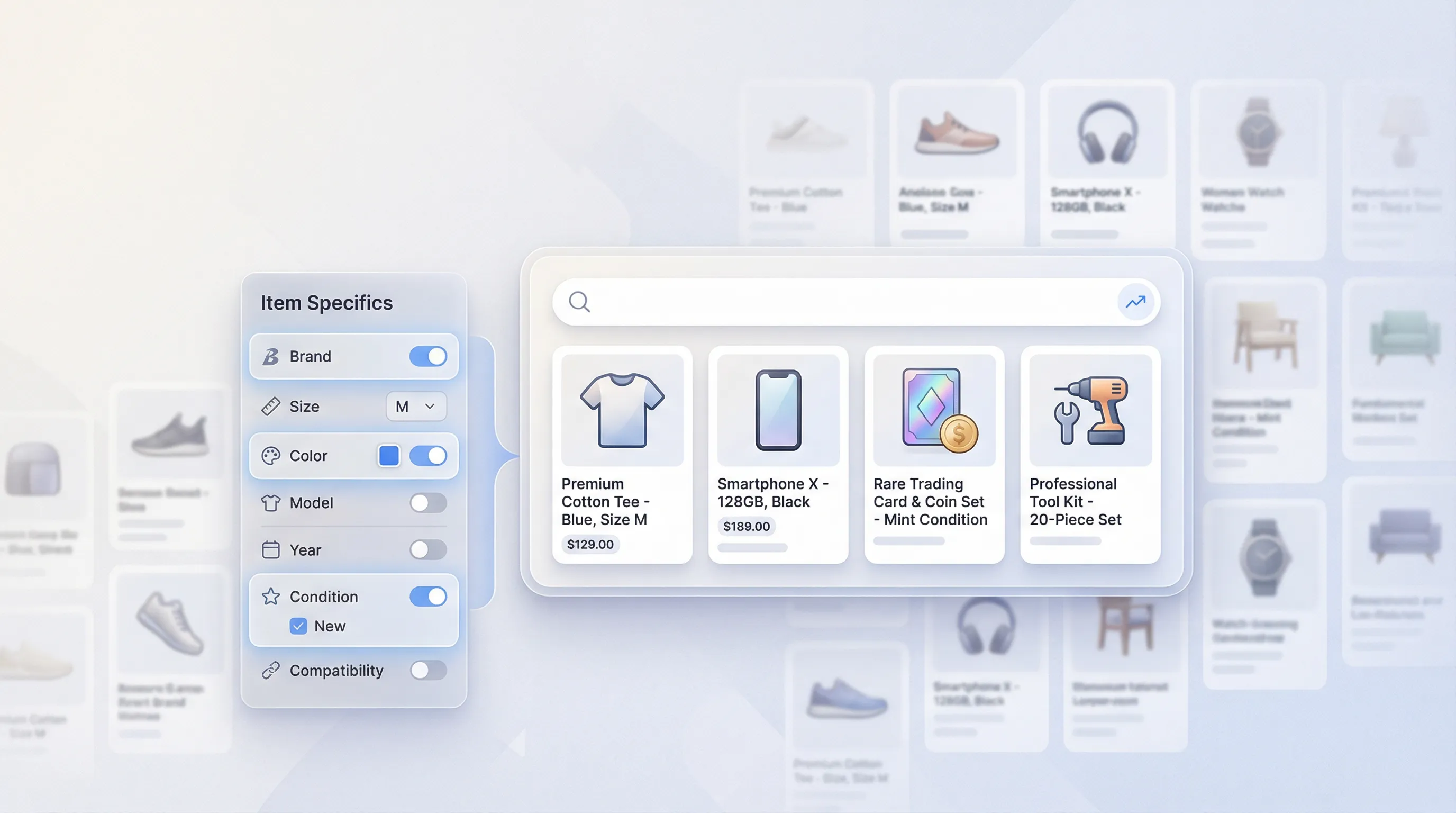
In online marketplaces like eBay, Etsy, and Amazon, search algorithms rank listings using dozens of factors. The goal is always to match buyers with the most relevant, complete, and trustworthy listings. Factors such as keyword relevance, listing completeness, price (including shipping), seller performance, and listing quality all play a role in where your item appears.
In short, more complete and accurate listings with competitive prices, clear terms, and great service rank higher. Below we break down the key factors that influence visibility and offer a step-by-step checklist to improve your listings.
Marketplace algorithms favor listings that are thorough, relevant, and buyer-friendly. Master the five key ranking factors - keywords, completeness, pricing, seller service, and engagement - to dramatically improve your visibility and sales.
1. Use Relevant, Keyword-Rich Titles and Descriptions
Search engines begin by matching buyer keywords to your listings. Use clear, concise titles packed with the most important words a buyer would use (e.g. brand, category, color, size). Avoid filler words and spelling errors. Platforms like eBay explicitly note that listings should match buyer searches "as closely as possible".
Similarly, on Etsy and Amazon, using relevant tags and keywords in titles and tags boosts your ranking. For example, Amazon advises sellers to include primary keywords in the product title (brand, product type, color, material) because "product titles are a great place to use the primary keywords".
Keyword Optimization Checklist
- Include 3-5 of the most relevant keywords in your title (no keyword stuffing). For instance, "Men's Blue Oxford Shirt - 100% Cotton, Size M" covers product, material, color, size.
- Use all available keyword/tag fields (Etsy allows 13 tags). Include synonyms and alternate terms in your description.
- Ensure correct spelling and grammar; most buyers use correctly spelled queries.
- Fill out item specifics or attributes (e.g. "make, model, color" on eBay) as completely as possible. These help the system match your item to filtered searches.
Having relevant keywords in both title and description helps the search engine evaluate your listing's relevance. In short, if your title and description accurately match the buyer's query, your listing is more likely to appear higher.
2. Complete and Detailed Listings (Item Details & Photos)
Complete, detailed listings rank higher because they give buyers (and the algorithm) confidence in the item. Make sure to fill in every field: detailed descriptions, all item specifics/attributes, correct category, and so on. For example, eBay's Best Match favors "complete listings with detailed descriptions, multiple high-quality photos, and proper categorization".
Similarly, Etsy's search rewards listing quality: each item should include multiple high-quality photos and even a return policy to boost buyer trust.
Listing Completeness Checklist
- Write a clear, thorough description. Highlight key features and usage. Use bullet points if supported.
- Upload multiple high-resolution photos (eBay allows up to 24 free photos). Show the item from various angles and any flaws. For Etsy/Amazon, use all image slots. High-quality photos are critical - eBay and Etsy note that multiple clear images help listings "stand out".
- Include all item specifics or attributes (color, size, material, condition, etc.). These fields improve filtering and matching. (E.g. on eBay, adding make/model/size can dramatically increase visibility.)
- Choose the most specific, accurate category. Mis-categorized items may be hidden in search.
Good product photos and details not only improve ranking but also click-through and conversion. Listings with clear, detailed content are more likely to engage shoppers and convert to sales, which in turn signals the algorithm that your listing deserves a higher rank.
3. Competitive Pricing & Shipping
Pricing is a major factor. Marketplaces compare your total cost (price + shipping) against similar items. A slightly higher-priced item with free or fast shipping can outrank a cheaper listing with steep shipping costs. Amazon explicitly recommends adjusting prices to stay competitive to "improve your product ranking".
Likewise, offering free or expedited shipping can boost visibility on eBay and Etsy. Etsy even considers high shipping costs as a negative factor for U.S. listings.
Pricing Optimization Checklist
- Research similar listings to set a competitive price. Don't just be the cheapest; factor in shipping costs. For example, eBay rewards reasonable total cost, and on Etsy high shipping fees can lower your rank.
- Offer free shipping if possible, or at least low flat-rate shipping. Clearly display shipping time. Fast shipping times (1-2 days) are a plus.
- Take advantage of tools: Amazon's "Automate Pricing" can help match competitors; eBay's Global Shipping program and Etsy's shipping profiles can simplify offering free shipping.
- Include handling time and international shipping options. Be transparent about costs and delivery time in your listing terms.
Competitive pricing isn't just about being low; it's about giving value. Think total cost to buyer. Even on Amazon, price-competitiveness drives the Buy Box and organic ranking. On all platforms, good deals and shipping boosts sales, which further improve your placement.
4. Excellent Seller Service & Reputation
Marketplace algorithms favor sellers with strong performance and customer satisfaction. Key metrics include feedback score, review ratings, on-time shipping, and low cancellation/refund rates. For example, Cassini (eBay's search engine) places top-rated sellers above others.
Etsy explicitly factors in shop service quality (average reviews, response rate, and case rate over the past months) when ranking. Amazon similarly rewards good account health and customer feedback - factors like FBA fulfillment (fast shipping) or positive reviews can improve search placement.
Seller Service Checklist
- Maintain a high feedback rating (aim for 4.5-5 stars). Resolve any buyer issues promptly and politely.
- Ship promptly and provide tracking. Late shipments hurt your standing.
- Offer a clear, reasonable return/exchange policy. Sellers with no or hard returns policies often rank lower.
- Respond to customer inquiries quickly (e.g. within 24 hours). Excellent communication boosts conversion and signals quality service.
- Keep your inventory accurate. Avoid cancellations for out-of-stock items - canceled sales and refunds drag down your metrics.
Great service leads to positive reviews and repeat customers, which in turn signals the search algorithm that your shop is trustworthy. Etsy's search guide notes that strong customer service and high review scores help listings rank higher. In practice, a shop with consistent 5-star reviews and fast shipping will outperform one with identical products but poor scores.
5. Listing Engagement & Freshness
Search engines also learn from buyer engagement. Listings that get clicks, favorites, and purchases indicate relevance. Etsy, for instance, tracks a listing's conversion rate (views-to-sales). High engagement boosts ranking over time. On eBay, listings with lots of watchers and bids tend to float to the top.
A brief "new listing" boost is given when you list or renew an item (often a few hours to days), but a sustainable strategy is to improve relevancy and conversion rather than constantly renewing.
Engagement Optimization Checklist
- Promote your listings (social media, ads) to drive initial traffic. Early engagement can kickstart ranking.
- Update or renew stale listings periodically. For example, tweaking keywords or images can refresh interest. (Etsy gives a temporary search boost to new or newly-renewed listings, but don't abuse it.)
- Use analytics: review which listings get the least traffic, compare their tags/keywords to your top-sellers, and adjust.
- Encourage customers to favorite your shop or listing. Social proof can indirectly influence search (more favorites/views show popularity).
Remember that all platforms aim to show buyers what they are most likely to purchase. If your listing consistently underperforms (few clicks or sales), the algorithm will deprioritize it. Focus on relevance and conversion optimization - a listing that converts well will climb over time.
6. Complete Optimization Checklist for Marketplace Listings
Use this quick checklist to ensure you've covered the essentials for maximum visibility:
- Keyword Optimization: Use relevant keywords naturally in your title, tags, and description. Include brand, category, color, size, and other high-impact terms.
- Complete Every Field: Fill out all available fields (item specifics, attributes, categories). More complete data helps match searches.
- High-Quality Images: Upload multiple clear, well-lit photos (at least 3-5 per listing). Do not use watermarks or borders. Show the item and any flaws.
- Compelling Title & Description: Craft an informative title (avoid vague words like "Awesome" or "Cool"). Use bullet points or formatting in the description to improve readability.
- Competitive Pricing: Check similar listings and price your product competitively, offering value-added perks (free shipping, bundle, etc.).
- Shipping & Handling: Offer reasonable or free shipping. Clearly display shipping options and speeds. Fast handling times improve buyer trust.
- Customer Service: Keep a high feedback/rating score. Ship on time with tracking, respond promptly to messages, and honor your returns policy.
- Refresh & Promote: Renew or relist items occasionally to maintain visibility (especially if inventory or trends change). Use store promotions or paid ads judiciously if organic reach is slow.
- Monitor Analytics: Use each platform's tools (shop dashboard, traffic reports) to see which keywords and listings perform best. Optimize underperforming listings using insights from your top sellers.
By systematically checking each item on this list, you ensure that nothing essential is missing. This thoroughness is exactly what algorithms look for when ranking listings.
Before & After Examples: Listing Optimization in Action
Example 1: Vintage Lamp
Before: A seller lists "Vintage Lamp" for $50 + $15 shipping. The title is just "Vintage Lamp", and the description is one short sentence. There's only one dark, blurry photo and no item specifics filled in. The shipping time is default and return policy is unclear. The listing gets few views and no sales.
After: The seller changes the title to "Antique Brass Desk Lamp - Mid-Century Modern Light Fixture". The price is adjusted to $55 with free shipping. Five bright, high-quality images are uploaded (showing the lamp from multiple angles). The description now includes bullet points on condition, dimensions, and history. All item specifics (brand, color, style) are filled in. The listing now appears on the first page for searches like "mid century brass desk lamp". Improved visibility and sales follow from the better match.
Example 2: Handmade Necklace
Before: An Etsy shop has a listing titled "Handmade Necklace" with a single tag "necklace". Price is $25 + $8 shipping, and only 2 images are used (one is dark). Reviews are average. The shop has no clear FAQ or return info. As a result, this listing rarely shows up in search.
After: The title is expanded to "Boho Beaded Statement Necklace - Handmade Glass & Wood Beads", and relevant tags (e.g. "boho necklace," "statement jewelry," "gift for her") are added. The seller adds more photos (close-ups and model shots) and sets shipping to free. The product description now details materials and care instructions. The shop profile is updated with shipping and returns info. This more complete listing starts ranking higher for boho necklace searches and receives double the usual favorites and purchases. (Better keywords and service drove the improved rank.)

Each "After" scenario follows the above checklist: rich keywords, complete details, great photos, competitive pricing, and clear policies. As a result, the listings "get seen" by more buyers and climb in the Best Match/search results.
Ready to create optimized marketplace listings in seconds? Start your free trial - PicSellence uses AI to generate listings with all the ranking factors in mind.
Conclusion
Search ranking algorithms on marketplaces like eBay, Etsy, and Amazon reward listings that are thorough, relevant, and buyer-friendly. The key factors - relevant keywords, complete information, competitive pricing (especially shipping), quality photos, and strong seller metrics - all work together. By following the optimization checklist above and learning from the before/after examples, sellers can systematically improve their listings.
In practice, optimizing your listings increases visibility, traffic, and sales. Marketplace help guides all emphasize this approach. For example, eBay's own seller resources state: "To improve your Best Match ranking, make sure your listings are complete and accurate, and offer competitive prices, reasonable shipping, and great customer service." The effort pays off: well-optimized listings rise toward the top of search results, while neglected listings fade to page two or beyond.
Keep iterating: monitor performance, tweak titles and prices, and maintain excellent service. Over time, these best practices will help your listings stay visible and draw in more buyers.